Keeping the glitch on the record: Tad Eam in conversation with Viv Zito
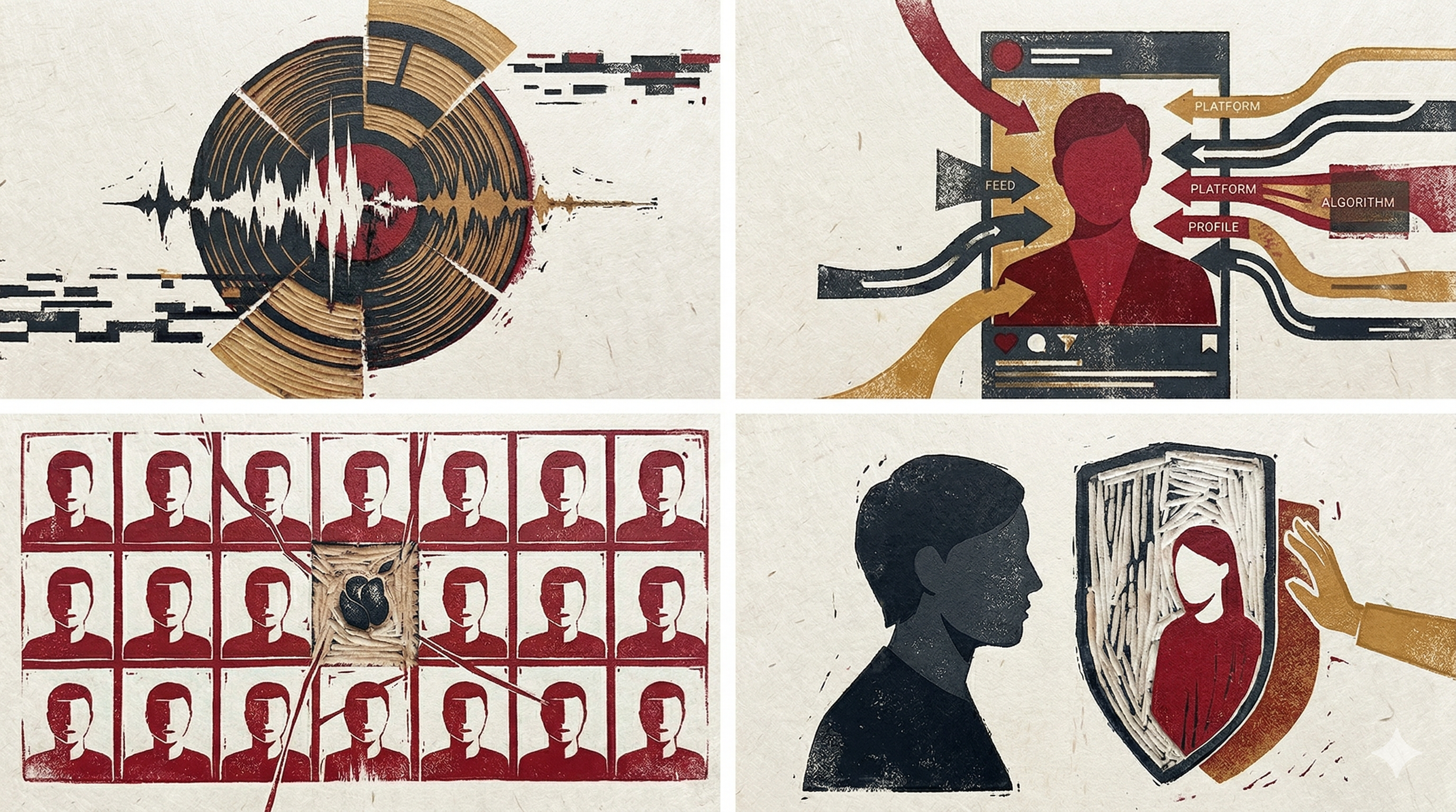
Vivian Zito and Tad Eam on glitches, archives, and what it means to feel ‘authored’ in public, recorded in a Fort Greene café across from BAM.
Brooklyn, early spring. Two people at a small table talk about endings and archives.
Vivian Zito is a London‑raised archivist, writer, and cultural historian whose work threads together underground music scenes, translation practice, and the stories that slip through official records. She spoke with our editor, Tad Eam, about glitches, archives, and what it means to feel ‘authored’ in public.
brooklyn now, beatles then
Tad Eam (TE): Viv, it’s been a while since the days when my group chats were full of links to the Beatles60 podcast you produced. Can you sketch the jump from that phase of your life to what you’re doing now?
Vivian Zito (VZ): Beatles60 feels like a lifetime ago and also like last week. I was behind the scenes there — producer, archivist, occasional chaos‑coordinator — while Andy and Larry did the talking. That show was very intimate for me because it was basically listening in on two people trying to think their way through a band that’s already been interpreted to death. When they wrapped it, it wasn’t because the material ran out. It was because their lives did what lives do — jobs changed, health stuff, new projects.
TE: Endings that aren’t tidy.
VZ: Exactly. Although… not that, exactly. Different. It wasn’t some big tragic finale, it was more like someone quietly turning off a tape machine in the middle of a really good sentence and then everyone arguing, after the fact, about what the end of the sentence was.
TE: I remember some of those forum posts. They were brutal.
VZ: Oh, they were. I wasn’t really angry, I was just… staring at three servers that needed migrating and about six years of metadata that didn’t have a proper home yet. That was my first practical lesson in how audiences start to feel ownership over an ongoing text, even when your name is only in the credits.
TE: Did that change how you thought about working behind the glass?
VZ: It changed how I thought about being recorded, full stop. Once something becomes part of someone’s routine, they build a whole invisible structure around it. You feel that when it stops. That awareness has followed me into everything since — editing, archive work, film.
TE: You once said you liked the “mess” of it.
VZ: Did I?
TE: You did — at that East Asia panel.
VZ: Right, yeah. I meant the looseness, not pure chaos. Chaos is overrated. Looseness is that feeling that people are still thinking in real time.
TE: Did you see that cloud?
VZ: What, now?
TE: Yeah, that one. It looks like a smashed Abbey Road zebra crossing.
VZ: It really does. And that’s kind of it, isn’t it? Same cloud, but we’re already narrating it differently.
from beatles60 to kessels and editorial work
TE: So how do you get from producing a Beatles podcast to Brooklyn editorial life and regular bylines at places like KESSELS?
VZ: I moved to New York for grad school and somehow never left. I ended up on the editorial side partly by accident and partly because I like being behind the glass more than in front of it. I started filing short pieces and reviews for KESSELS and a couple of journals, then more longform essays, and eventually I was helping shape series and special issues.
TE: What kind of work is that, day to day?
VZ: On the surface it’s very boring. You’re reading drafts, moving paragraphs around, arguing about titles. Underneath, it’s all questions about framing: what do we put next to what, what do we leave out, whose reality gets to be “the” story. The through‑line from the podcast to Brooklyn is that I’ve always been interested in how much of a life you can show without flattening it. Like when the faders bleed and you still hear the room.
TE: And somewhere in there, Port Trinity shows up.
VZ: Port Trinity arrives as an email with way too many attachments. A screenplay draft, server dumps, images of a face that won’t behave for generative models, TikTok links, all of it. At first I treated it as just another strange archive. Wait, no — that was someone else on the project who said that, actually. I think I initially thought it was a prank. Then I realised it was also a live experiment in how much friction you can leave inside a public record before the platforms try to sand it down.
TE: Was there a moment where it clicked, like, this is more than just a messy folder?
VZ: Yeah. There was a night going through the server logs — timestamps all over the place, things half‑labelled, stuff duplicated for no obvious reason. It felt like the archive itself was resisting being cleaned up, like it didn’t want to be turned into one clean story.
documenting without killing it
TE: You’ve used the phrase “document something without killing it” a few times. What does that look like in practice?
VZ: With Beatles60, it meant letting digressions and uncertainty stay in. Andy and Larry didn’t speak in neatly cut thesis statements, and the show was better because no one tried to clean that away. In Brooklyn, on editorial desks, the impulse is often the opposite: find the angle, cut everything that doesn’t support it, make it easy to skim.
TE: Make it legible for people who are half reading on the train.
VZ: Exactly. And sometimes that’s necessary. But if you apply that flattening instinct to everything, you lose the texture of how something actually feels from the inside. You’d just have to listen to the raw stems from those sessions to hear the space between the thoughts. It’s hard to describe, but the work I care about — whether it’s a long essay, an archive page, or a film — tries to keep a bit of that texture. You still edit, you still make choices, but you don’t pretend the story told itself or arrived pre‑smoothed.
TE: Do you see that same tension in Port Trinity?
VZ: Very clearly. On one hand you have a very pragmatic digital desk: limited hours, messy servers, half‑finished tags. On the other you have this strong temptation, for everyone involved, to shape a neat arc: “Here is what this artist means.” My role has mostly been to nudge things toward the first reality and away from the second, while still acknowledging that every nudge is itself a kind of authorship.
TE: What do you think happened, the first time you realised you’d nudged too hard?
VZ: Mm. I caught myself writing a caption that sounded like a museum label for someone who was still very much alive and extremely online and kind of annoyed about it. That’s when I thought, okay, I’m not just preserving this, I’m framing it. Actually, forget I said that. That sounds more heroic than it was. Mostly I just went back into the doc and deleted three overconfident adjectives.
how platforms author artists
TE: You’ve written that a lot of younger artists “feel authored”. That’s a heavy phrase. What do you mean by that?
VZ: I don’t mean “fake”. I mean they can feel systems around them writing ahead of them. With Jae, for example, there’s this gap between what he thinks he’s putting out and what the platforms decide he is. He’ll post a harmless night‑cycling clip or a quiet studio photo. On the back end, someone tags a few things in a slightly queer way — not dishonestly, just… tilted. The recommender system grabs those signals and suddenly his face is being fed to a very particular set of timelines he didn’t consciously choose.
TE: So he isn’t waking up thinking, “I’m going to build a persona.” He’s waking up inside other people’s readings.
VZ: Exactly. And it’s not just “people”. It’s recommendation engines, search indexes, fan accounts, critics. You see this with fandom all the time. With Beatles60, listeners were shipping hosts with their own memories of records. With Jae, something like the Nishida Park night goes through that same machine: private encounter, then screenshots, then rumour, then manga panels, then classroom discussion. By the time he’s processed what happened, there’s already a stack of interpretations waiting for him.
TE: That’s the “hermeneutic reality” you write about.
VZ: Yes. It’s a reality that’s built from interpretations first. You’re living inside a commentary track that started rolling before you finished the scene. For a lot of artists under twenty‑five, that’s just normal life now. The platforms assign them a bucket, the numbers reinforce it, and it becomes very hard to tell where their own preferences end and the recommendation system begins.
TE: And that brittleness you mentioned elsewhere — you still feel that?
VZ: Yeah. Everything feels a bit brittle. Like one wrong post and the whole reading of you snaps to a different preset. That’s the mood he’s living in.
the tragedy of the batch render
TE: One of the most striking parts of the Port Trinity material is Jae’s attempt to build a digital twin. Can you walk through that?
VZ: Jae did what a lot of working models are quietly trying: he wanted to automate some of his image labour. So he fed generative systems with references of his face, his “don’t‑smile” look, specific angles. In theory, he should have got a flexible, controllable avatar back. In practice, the systems kept trying to fix him.
TE: Fix him how?
VZ: The models smooth away the asymmetries that make him recognisable. They add teeth where he keeps his mouth closed. They brighten his eyes, lift his lids, erase the tiny things he thinks of as biometric locks. The result is a grid of almost‑Jae faces that hit a commercial template perfectly and miss him completely.
TE: That’s what you called the “tragedy of the batch render”.
VZ: Right. From my side as an archivist, it’s tragic because the real subject gets diluted into one tile in a grid of near‑misses. None of those faces are “wrong” in the way a glitch usually is. They’re just… close enough. If you’re not paying attention, the batch render becomes more visible than the person. That’s where this feeling of “being authored” gets very literal for him. He can see, in image after image, what the system would prefer him to be.
TE: And once you’ve seen that, you can’t unsee it.
VZ: No, you really can’t. It’s like someone has run a focus group on your face without telling you.
the static inside and the android prompt
TE: How does all that feed into your screenplay, The Static Inside?
VZ: The screenplay takes those feelings and pushes them into a near‑future metaphor. Inside the film, there’s an android version of JG whose job is to perform a certain kind of desire — physical, emotional, online — on a loop. At a certain point he realises the loop isn’t his. It’s just a script executing. His “intense physical urges” turn out to be lines of code running on a schedule.
TE: It’s a pretty brutal moment.
VZ: It is. But it’s just an exaggerated version of something a lot of us recognise in miniature. You catch yourself wanting something very specific — a body type, a city, a way of living — and if you trace it back, you can see the prompt history. Ads, For You pages, likes, all stacking up. Android‑Jae is just living that realisation at, like, 130 percent volume.
TE: And there’s that outer frame in the script, where all that android panic is itself a text prompt on a screen.
VZ: Yes. That last layer is there to make the whole thing feel a little unstable. Inside the film, it’s an android’s existential crisis. Outside the film, it’s one more reminder that someone, somewhere, is always typing.
TE: It sounds like a lot of weight to put on a “hobby”.
VZ: It really is just a hobby for me, honestly. I don’t think of it as some grand cinematic statement; it’s more like a way to organise the tabs in my head.
authoredness as a survival strategy
TE: When you and Jae talk about this stuff, does it help him, or does it just make the anxiety more precise?
VZ: Both. But I think naming it helps. He jokes about his “authoredness protocol” — treating the on‑screen version of himself as a character he’s responsible for, but not confusing that character with his body. The idea is simple: assume the feed is co‑writing you, then decide what you still want to hold back.
TE: What does holding back look like, in practice?
VZ: Sometimes it’s as mundane as not tagging certain relationships, or letting some nights stay off camera. Sometimes it’s refusing to clean up a messy piece of lore just because the algorithm would like a clearer label. The point isn’t to disappear. It’s to keep a small, non‑negotiable core that doesn’t have to make sense to anyone except the person living it.
TE: That’s not advice just for artists.
VZ: No. It’s for ex‑podcasters, for students, for anyone who’s been posting long enough to have an accidental era. You can’t stop platforms and other people from writing around you. But you can decide which parts of your week become metadata and which parts just stay your week.
TE: Quick one — did you already say that about metadata versus the week itself?
VZ: Did I? I might have, yeah.
TE: It fits, though.
VZ: Yeah, I guess repetition’s part of it. The feed repeats you back to yourself until you recognise the pattern.
age, london gigs, and now
TE: Can I zoom out for a second? You were a teenager going to gigs in, what, ’77?
VZ: ’77, yeah. Sixteen, squeezing into rooms I probably shouldn’t have been in yet. Hope & Anchor nights when it was too hot to breathe, the Marquee when you could still feel last week’s gig in the carpet.
TE: Back then, if you wanted to be seen, you wanted to be cool and admired, right? But you didn’t stand there announcing, “look how good‑looking I am”.
VZ: God, no. You wanted to be seen, but it had to look like an accident. You’d spend an hour getting your hair right just to pretend you’d rolled out of bed like that. If you’d stood in the middle of the room and basically done a thirst‑trap pose, people would’ve laughed you out the door.
TE: Whereas now teenagers are sort of forced to present like, “I know I’m attractive and interesting, here’s my brand”.
VZ: Yeah. Even the shy ones. It’s like the default setting is “model audition tape”. Everyone’s supposed to have a personal logo, a colour palette, a grid. Youth today are doing this compulsory self‑confidence performance just to keep up. And the horrible punchline is that even when it works — even when they go viral — it’s so ephemeral. The market for that stuff is enshittified from top to bottom. You can be the person of the week and then you’re gone, and you still owe tax on the brand deals.
TE: But the 1977 local stars still live in memory.
VZ: Exactly. The coolest person in the room at the Hope & Anchor never had a million followers, but forty years later people still talk about how they walked, how they held a cigarette. It’s tiny, but it’s sticky. That’s the sad bit for me: the kids now get reach without roots.
TE: On the other side of it, though, there’s more room around gender and presentation now.
VZ: Completely. Back then, even in punk, most of us made sure we read as very straightforwardly cis in day‑to‑day life. You could push at the edges a bit — hair, clothes, attitude — but there were lines you knew not to cross if you wanted to get home in one piece. Things were opening up, but it was still pretty rigid. Now I see teenagers treating gender as something they can actually move around in, not just hint at. That makes me weirdly hopeful.
TE: So more freedom now, but also more pressure to package yourself.
VZ: Yeah. They’ve got this incredible vocabulary for who they are, and at the same time they’re being asked to monetise it before they’re finished growing. We got less freedom, but we also got to make some of our mistakes off the record.
TE: And the scenes themselves? ’77 vs 2026?
VZ: Scenes then were really centralised. You had a handful of rooms, a couple of record shops, maybe a pirate station, and that was your universe. If you didn’t like what was happening there, you were stuck. Now it’s the opposite. There are a thousand niche subcultures layered on top of each other. A kid in Croydon can be deep in some micro‑scene that barely exists in their own postcode. It’s brilliant, but it’s also disorienting. You don’t always know where the “centre” is.
TE: So if a sixteen‑year‑old at the Marquee in 1977 and a sixteen‑year‑old on TikTok in 2026 both asked you for one line of advice, what would you give them?
VZ: Don’t give all your best moments to other people’s machines. Keep one song, one night, one ridiculous crush that only exists in your own head. The rest we can argue about later.
living with the glitch
TE: If someone reading this is twenty, posting, and already feeling a bit “authored”, what would you actually tell them?
VZ: Three small things. First, pay attention to what the system keeps trying to push you toward. That’s not your fate, but it’s useful to see the shape it wants. Second, keep something unposted on purpose — not as a secret brand asset, just as proof to yourself that you still have a private channel. And third… um, I probably shouldn’t tell you this, but don’t panic if you feel a bit like a character. Everyone does, on some level. The trick is to remember you’re also the person who closes the laptop.
TE: What do you think happened to make that feeling so ordinary, so quickly?
VZ: A miserable cocktail of cheap storage, always‑on cameras, and platforms that pay people in attention instead of money. And also just… people being people. You give us a grid and a timeline and we start arranging ourselves into seasons.
TE: That’s a good place to stop.
VZ: We can always add an appendix later. That’s the editor speaking.
TE: You think the readers would want one?
VZ: Honestly? The appendix thing was Larry’s idea when we were wrapping 007. He always wanted to leave the door open. Me, I’m happy to let it end here.
TE: Happy‑ish.
VZ: Yeah, happy‑ish. If someone wants to send a follow‑up question later, I’ll probably answer it. That’s more how it works now, isn’t it?
