Notes from the Constructed Identities Room
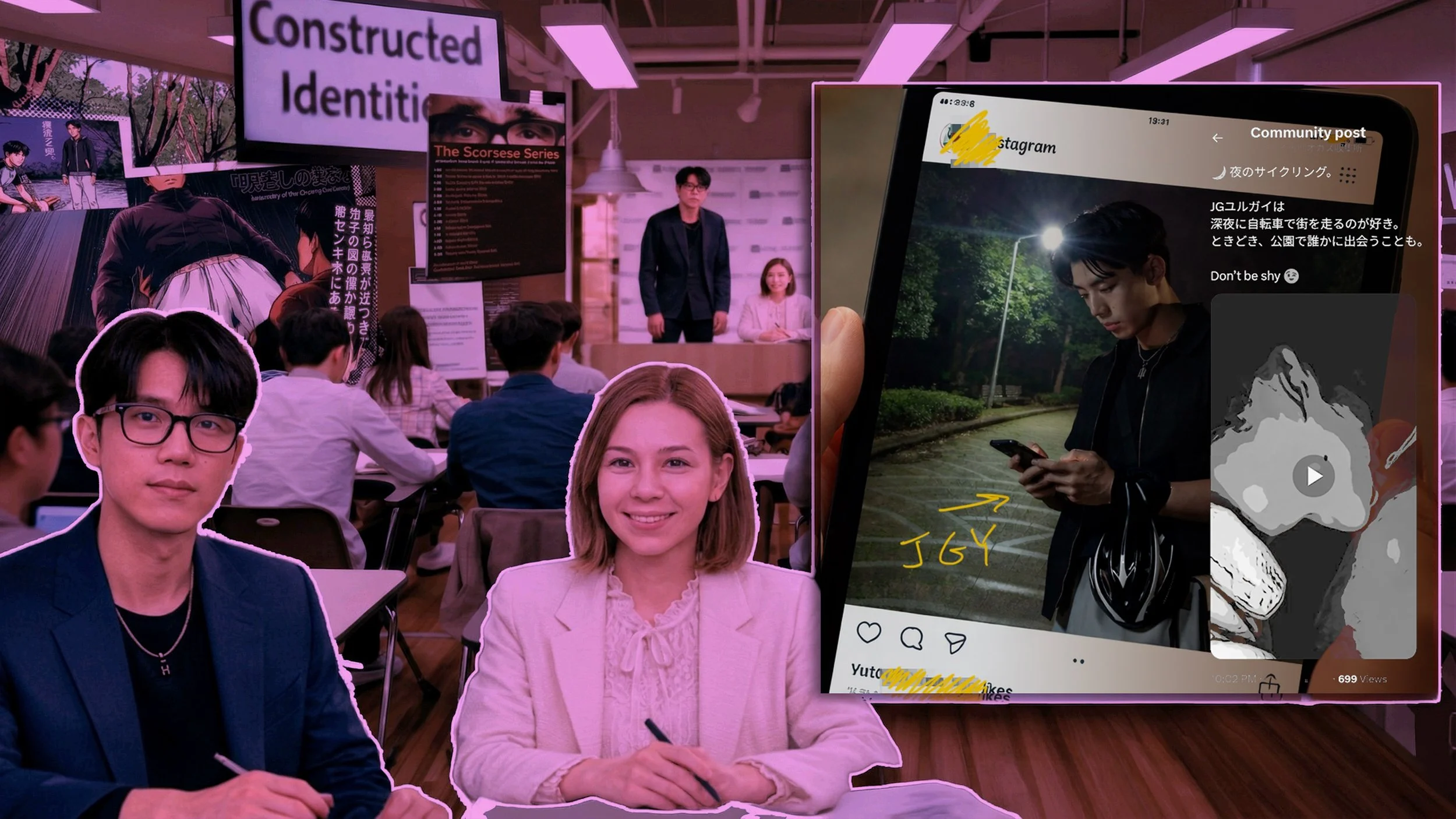
JG Yuruguay and Vivian Zito
What follows started as gossip, screenshots, and half-remembered threads, then got run through a few more layers than most stories are willing to admit. It isn’t straight reportage, and it isn’t pure invention either; call it an augmented account that tries to get closer to the shape of what happened than any single post could manage.
The park sequence in particular moves at the speed people told it to me, too slow for plot, just right for how the night sits in their nervous systems, so if you need to skim the inches to feel the miles, I won't be offended. The people involved read, argued over, and signed off on this version; names, handles, and a few angles have been shifted just enough that nobody gets outed or slandered, but not so much that the truth of it goes missing.
The room at Tisch smelled like warm plastic and nerves.
It was one of those mid-size seminar spaces they use for upper-level film theory and “critical practice” stuff. Low ceiling, fluorescent panels that hum just enough to make you wonder if the tinnitus is back, projector hanging like a small moon over the front table. The university had rebranded the course cluster as something like Screen Futures or Expanded Cinema, but underneath it was still the same old mix: kids hungry for theory, kids hungry for careers, and a few who just wanted to be near anything that felt like a scene.
Port Trinity Archives had floated the invite weeks earlier: special session on Constructed Identities, guest appearance by their main artist JG Yuruguay, moderated by screenwriter Vivian Zito. It’s one of those cultural convergences seemingly converged just for me, as I live in that weird overlap between Japanese music Twitter, queer X.com, and people who still care about structuralist film, so the notice hit every one of my feeds at once. Alumni status still gets me a backdoor into these things if I knock on the right door and pretend I’m doing a piece, which I am, eventually.
By the time I walk in, the projector is already throwing up title cards: CONSTRUCTED IDENTITIES in block type, some manga panels in the margins, a Scorsese series flyer half-covered by a taped note. Students are sliding into chairs, laptops open, phones half-hidden on thighs. On the front table: two water bottles, a stack of marked-up script pages, and the Port Trinity logo on a modest little placard that looks like it was printed fifteen minutes before showtime.
One of the title slides shows a featureless chrome android built from stacked screenshots of JG’s own face. Nobody comments on it. They’re used to seeing more than one version of him on the screen at once.
JG sits to the left, blue jacket, black shirt, chain catching the overhead light every time he shifts. You’d recognize him from the grid even if you didn’t know the name. There is that particular calm he has when a camera is around but pretending not to be around. Zito is on the right, blazer over lace, everything about her saying “I can talk to you about both Wong Kar-wai and file-naming conventions.” The room knows her as the writer. The room knows JG as the feed.
I grab a seat toward the middle, close enough to watch faces, far enough that no one is going to call on me.
Zito opens with context. She talks about their screenplay, The Static Inside, and how it grew out of this cross-Pacific correspondence with a musician who kept sending her fragments: liner notes, IG captions, DMs about night cycling and metadata. She keeps her tone light, but the language is tight: archive, authorship, erasure, logistics of desire—all the good phrases that make tuition feel worth it.
JG lets her talk for a while. When she finally invites him in, he leans toward the microphone, then away from it, then just talks in his normal voice, which somehow still fills the room.
He starts with something about “functional grids” and “unsettled top layers,” and you can hear the kids who’ve listened to the tracks nodding without realizing they’re nodding. He mentions John Foxx. He mentions Tuxedomoon. He says his ideal is music that can do work, keep you focused, keep you moving, while carrying a line of tension that never quite resolves. You can tell some of them came for this part, gear talk disguised as theory.
That’s the official, public-facing layer of the day.
The unofficial layer began months earlier, in a park in Nishinomiya, with someone who wasn’t thinking about seminars at all.
Nishida Park, That Night
The boy’s name is Yuto, though his handle is something else, and I’m not going to use either here. He’s nineteen. It’s his second time going to Nishida Park at two in the morning. He isn’t looking for JG. He’s looking for a particular kind of silence that usually ends with someone on their knees.
He knows the park has a reputation. He also knows it isn’t advertised that way. It’s one of those places you hear about in DMs and half-joking comments, a spot that sits just far enough from the main roads that the sounds get strange. Trucks on Route 171 rumble like distant bass. Wind moves differently through trees when no one else is around. You get the idea.
What the algorithm has done, long before he gets to the park, is make JG’s face familiar.
Not as a musician. Not really. Yuto follows him because of the bike videos, the lounging shots, the grid of carefully casual selfies. JG is one of those guys the Japanese side of TikTok has decided is both reachable and aspirational: “he could be on the train next to you but also he looks like he walked out of a drama.”
So when Yuto sees someone deeper in the garden under the lamp that night, bike helmet next to him on the wooden bench, chain catching just enough light, he has that double reaction: one part “cute guy, potential,” one part “wait, I know that profile from somewhere.”
Strangers in the night, exchanging glances. In fact, a connection is about to be made. What happens next will become known as “the incident.”
But how do I know all this? I wasn’t there, witnessing from behind a shrub. The story came via Yuto’s Instagram account. The detail didn’t surface all at once; it arrived in layers.
At first it was the BL girls, the usual cross-feed crowd of Japanese high schoolers and university kids who already knew JG from thirst edits and who treated the whole thing like a live-action manga panel. They’re the ones pressing gently at first:
ほんとに?
どっちから動いたの?
沈黙どのくらい続いたの?
それってこの前ストーリーに出してたG-STATIONのやつ履いてたの?
Questions about the silence. Who moved first. Whether he hesitated. One of them even asking if he had been wearing those bright G-STATION briefs from his story the other day.
Yuto answered in fragments. Ellipses. Laughing emoji. A “you’re crazy” here and there. The thread grew.
Only later, when the conversation edged closer to the mechanics, did the tone shift. The BL girls stayed for atmosphere. The gay boys arrived for precision.
まじで?
最初からしゃぶり?それとも途中から?
どうしてJGYがしゃぶってくれるって分かったの?
飲んだ?
Now the questions turned practical: was it oral from the start or later, how he knew JGY would go along with it, whether it went all the way to the end.
There’s a difference between wanting the romance and wanting the logistics. The feed, predictably, wanted both. Each of Yuto’s replies was a little more specific than the last, pushed out by strangers who refused to let the scene stay coy. What follows reconstructs his many notes in that viral post, details that accumulated under that algorithmic and youthful pressure.
I only have Yuto’s own comments, the echo chamber of the threads, and my imagination to work with; everything from JG’s side is an inference, not a transcript. I’m confident enough to write it this closely only because Yuto kept circling back to the same sensations, angles, and beats, until his fragments started to read like stage directions.
So, rewind. Back at the park that summer night last year. We don’t really know JG’s perspective at the moment it’s about to happen. He must’ve seen Yuto entering the garden inside the large, empty park. He certainly sees him when he’s suddenly standing less than an arm’s length directly in front of where he’s seated. He probably expects the young guy to ask him something, or make some kind of chat. But no.
What happens next is password protected. See the password in the link button:
There’s a version of what happens next that people kept asking me to spell out, down to the inches. That version lives somewhere else for the ones who really want the logistics, especially if what you’re after is male‑on‑male casual sex in a park in uncomfortable detail; hit the button below if you insist.
When it’s over, Yuto is the one who steps back first. JG stays seated a beat longer, hands resting on the bench as if grounding himself. The lamplight still hums. The path still curves. His phone fits back into his hand as if it had never left.
But something in him has crossed a line he hadn’t drawn.
Later, in seminar rooms and interviews, he’ll talk about middle zones, about algorithms, about identities that drift. What he avoids saying is that the hinge lived in the body rather than the theory. It was quiet, warm, and decided in a stretch of time where neither of them moved, until they did.
Yuto gets what he came for. So does JG, in a way he probably didn’t anticipate when he left the house that night.
They don’t exit in a romantic two-shot. They sort of drift out of the garden at the same time, walking the short path back to the main stretch of the park without quite looking at each other. At the edge of the trees Yuto mutters a quick 「ありがとう」 without meeting JG’s eyes; JG gives a small nod that could mean anything and keeps moving.
By the time they hit the curve in the path they’ve separated into two solo figures again. JG stops under the lamp, pulls his phone out like he’s finally remembered it, and checks the screen.
That’s when Yuto takes the picture.
It isn’t explicit. It isn’t even obviously sexual. It’s just a guy in black under a streetlamp on a curving, empty park path, head down, face lit by the cold white of parks department LEDs, thumbs on his screen. Yuto posts it to Instagram with a short caption that mentions the bike helmet on the bench and a geotag that says “Nishida” (which might as well be anywhere).
The louder framing comes later, when someone in a queer X community reposts a screenshot of the IG story with a yellow arrow drawn over the pavement pointing straight at him, plus a 夜のサイクリング line and an English “Don’t be shy” that turn the whole thing into an invitation.
From Post to Lore
The post goes up on Instagram with a geotag that says "Nishida." The audience is small at first: mostly BL readers and K-pop fans, almost all Japanese, who know Yuto from school, from stan accounts, from the usual overlapping circles. They know how to read a suggestive caption. A few of the BL girls in the comments assume the bench in the photo is where it happened, which makes sense if you’ve never had to learn the topography of cruising. Yuto corrects them, a little amused, saying it was “inside the small garden, not here.” The women in the thread read that as extra romance; the boys read it as a map.
Comments accumulate fast. Most are some variation of “no way,” “lucky,” or the emoji chains that stand in for the things you don’t say directly. A few people recognize JG. Others pretend to. The combination of almost-celebrity and almost-explicit encounter pushes the post past the normal gravity of Yuto’s feed.
By late summer, screenshots have made it to X. Someone in a Japanese gay men’s circle shares the image with more direct commentary. The story gets told and retold: this is that guy from TikTok, this is what happened in the park, this is how long they stayed motionless before anything happened. Details shift in the retellings, but the structure stays: a silent negotiation, a first for one of them, a sense that the algorithm had brought them together in a way that was both creepy and weirdly inevitable.
It doesn’t take long before a small underground manga artist picks it up.
The manga is black and white, dense inks, heavy on crosshatching and foliage. It never names JG, never names Yuto. It doesn’t have to. Anyone who’s seen the IG post and the TikToks can map the shapes. The panels focus on the geometry more than the body parts: bench, path, lamplight, the line of a bent neck, the distance between knees. Dialogue is minimal. When it comes, it’s about the pull between script and will, about feeling like desire is executing on its own program.
By that point, JG’s grid is already drifting. His older clips still look like a normal boy in bad apartment light; the newer ones have that aggregator sheen, skin too smooth, proportions sliding around the edges. The manga just turns that visible drift into theology. It names the glitch an android and gives him a central processor and a creation myth instead of a terms-of-service agreement.
The key is this: the manga fades to implication just when the actual encounter becomes explicit. It holds the line where Zito’s screenplay, later, will cross it.
By early fall, JG knows about all of this.
Friends send him links. Some are amused. Some are worried. Port Trinity staff have a meeting that I’m not in, but I can guess the agenda: questions about liability, image, how much of your artist’s sex life you can let turn into fan fiction before you have to make a statement. They decide not to make a statement. That decision becomes its own kind of statement.
When I first hear about the park incident, it’s through a blurry screenshot of the IG post in a Line chat, forwarded by someone who knows I live in this weird intersection of Japanese language, queer internet, and music writing. I read the caption, read the comments, and feel that familiar combination of curiosity and unease: this is someone’s private moment, and it’s also clearly already public property in those circles.
I assume, wrongly, that it will stay there.
Instead, it keeps echoing outward.
In September, Zito folds the park into the screenplay. She doesn’t recreate the IG photo directly, but you can see the DNA: the curved path, the lamp, the almost-silence that goes on longer than you’d expect in a film scene. She structures the sequence so that it becomes a hinge point for the android version of JG the manga has already invented, a sentient clone assembled from glitched clips and fan edits. On screen, that android persona, the algorithm’s golden boy, is forced into collision with an unscripted, physical demand.
By the time October rolls around and we’re all sitting in that Constructed Identities room, the park has become an object lesson. Half the people in the room don’t know it. A handful do. JG and Zito have to pretzel themselves around NDAs, tacit agreements, and the fact that university seminar rooms aren't the place to unravel someone else’s late night.
Port Trinity, for their part, holds the line through winter.
No interviews mention Nishida by name. The official site sticks to ports and metadata and archives. The park lives in the unofficial channels: X threads, manga pages, DMs where people swap slightly embellished versions of the same story.
Then March comes, and the embargo quietly lifts.
The JG Yuruguay site (not the Bandcamp, not the streaming platforms, but the artist’s own domain) finally puts the park incident on the record. Not in full transcriptive detail like I did just now in that separate page, and not as some kind of confession either. More like a carefully written case study, you know? Fair enough. It talks about how a single encounter, filtered through an algorithmically primed gaze, became fan lore, then manga, then part of a screenplay, then a ghost in a seminar that everyone pretends is purely theoretical. The whole turn of events does, after all, amount to what feels like a transmedia unfiction inviting us all to join in.
That’s when I decide it’s fair game to write this.
Which brings us back to that afternoon at Tisch, the second half of the seminar where the park incident finally became the elephant in the room.
The Seminar Turns
Back at Tisch, in the Q&A at the end when a student in the front row asks the first real question.
She wants to know how the algorithm fits into his idea of identity, not in the vague “social media is bad” way, but in the literal sense: does he feel like TikTok and the dating apps have rewritten who he is attracted to, what situations he ends up in, what kind of story he is even allowed to live?
It’s a good question. It’s too good, maybe.
JG thinks for a second, then shrugs in that way where the shrug is doing more work than the words.
He says he grew up liking women, still does, that he has always been comfortable around men but didn't think of himself as moving that way until the apps started feeding him a particular mix of faces and bodies. “The algorithm steered me,” he says. “I fed it. It fed me back.” He calls himself “omnivorously straight-ish queer,” and the room laughs because it sounds like a joke, but he kinda fails to land it as a joke.
He talks about this middle zone he cares about. Not coupledom. Not anonymity. Neither top nor bottom (in the men-for-men space). Something in between, where the encounter is real but doesn’t have a label built in. The kind of space that isn’t built for a narrative yet, where there’s no caption baked into the architecture.
Ren, who’s sitting next to me and pretending not to be affiliated with Port Trinity, leans in and whispers, “He’s really going there.” I give him a little nod. He is.
Another student asks about the park scene in the screenplay, why it is explicit when the manga version of the same material is coy, why one medium gets the fade-to-black and the other gets almost uncomfortable detail.
Zito sits up for this one.
She says the manga’s withholding is part of its power. It lives in suggestion and negative space, in the way you fill in what you are not shown. The screenplay, she says, is dealing with a different machine. Cinema is already saturated with spectacle, so if you stay coy there, you get swallowed by everything else that is screaming for attention. In her words, it’s about exposing the script that is already running underneath: who moves first, who looks away, how desire has been pre-programmed by a feed you did not design.
She starts quoting her own abstract, “the android as mislabeled freight,” “digital subjects routed through a global logistics grid,” “phonetic erasure and the weight of the gaze,” and you can feel the seminar room relax. This is the comforting part, theory as airbag.
What they do not know is that there is a parallel script running under the seminar itself.
During the break, a cluster of people, me included, had slipped out into the hallway. The usual: bathroom, vending machine, hallway gossip.
Someone who knows the Tisch layout mentions that the only machine with actual cold drinks is down on a lower level, so a small cluster of us slips through the fire doors.
The heavy door to the landing doesn’t quite seat properly, leaving a sliver of open space that cuts into the dim light of the hallway. Inside, JG and a female grad student are pressed against the wall in that half-clumsy, half-practiced way people use when they think the space is private but haven’t actually checked the sightlines.
He hears us before we can back away. He doesn’t bolt or look ashamed; he just shifts enough for the overhead light to catch the chain on his neck. He locks eyes with our group for a split second and brings a single finger to his lips—a slow, deliberate “shh” that recruits us into the unofficial layer of the day.
Back in the room, Zito resumes her role as structural ballast. During the Q&A, JG leans into the mic and mentions—almost as an aside—that a concrete stairwell is a more radical space for art than any gallery. Half the room tries not to let their eyes flick toward the door. Ren gives me a look that says, “This is going to be a nightmare in the debrief.”
Living Inside the Algorithm
What strikes me most, looking back on the chain of events, is how every step is routed through a platform logic that no one person is really steering.
Yuto doesn’t go to the park because of JG. He goes because he heard the park is a certain kind of place, the way older generations used to talk about cruising grounds without geotags. The algorithm’s role comes earlier: in who fills his For You page, in what kind of bodies and faces get encoded as “possible,” in what makes his heart move enough that he saves a video.
JG doesn’t go to the park thinking, “tonight I’ll be in a manga.” He goes because he likes riding at night, because the park sits at a particular bend in his usual route, because it’s a quiet place where the static in his head sometimes shifts into something like melody. The algorithm’s role is in the audience he already carries with him, whether he wants to or not: every time he sits under a streetlamp now, there is a chance someone nearby has already seen him in some other light.
The “decision” to turn the encounter into content feels personal, Yuto pulling out his phone, but the frame is already there. Instagram gives him the tools: geotag, caption, story format, arrow stickers, metrics. The post has to be about something, in that grammar, and “had a nice quiet walk” is not what the interface is built to reward. Yuto was not aware of the unspoken rule that you do not out people you encounter in these places, or if he was, the impulse to feed the grid overrode the etiquette of the garden.
The post gets traction not because Yuto bought promo, but because the platform is very good at finding other young people whose attention patterns rhyme with his. The BL and K-pop crowd is already tuned to certain beats: older guy / younger guy, anonymous encounter, the thrill of maybe recognizing someone from your screen in your neighborhood. The platform connects those dots faster than any human gossip chain could.
X picks it up because someone wants to talk about the ethics, or just the thrill, in a slightly different register. The gay men’s circles there are smaller, older, and have their own vocabulary for this stuff. They retell the story with more detail and less emoji. The manga artist who turns it into panels only needs one or two of those threads to get the bones of a scene.
By the time academia meets it—in the form of Vivian Zito sitting under a projector at NYU—the story has already passed through at least four layers of transformation. Real encounter, IG caption and comments, X retellings, manga adaptation, conversations among friends and managers. Each layer flattens some things and sharpens others. Each layer also serves a different audience.
The part that feels most 2026 about all this has little to do with explicitness. People have been doing explicit things in parks forever. What stands out is the speed and confidence with which everyone turns those moments into narrative objects.
Yuto doesn’t just want to remember what happened. He wants to mark it, share it, maybe be believed, maybe be envied. The post reads two ways at once: “this happened to me,” and also “this is the kind of life I am living,” which lands differently.
The little BL–K-pop friend network wants more than the story itself. They want the performance of knowing it. Quote-tweet it, meme it, name-drop it in DMs. They become co-authors of the legend without ever having to step into the park themselves.
The manga artist draws a scene and a mirror at the same time. Their version of Nishida is less about the leaves and more about the atmosphere of being watched and watching yourself be watched. They turn Yuto and JG into types. The reason sits in the medium itself, which rewards archetype: “that guy from TikTok,” “the kid who went looking for something,” and eventually, the yellow arrow on the pavement.
Port Trinity manages the artist and the story around him. Their silence is as strategic as their speaking. By not confirming or denying for months, they let the unofficial channels do their work. By eventually acknowledging it on the site, they pull the story back into the frame they control: the archive, the meta, the critique.
And then there’s JG, sitting in a seminar room days like the one I watched, answering questions about algorithmic hauntology and “functional grids” while half of his life is busy writing its own footnotes elsewhere.
He is not naive about this. When he talks about apps steering him, or the way certain kinds of bodies started showing up on his screen after he lingered on the wrong clip for a second too long, he sounds less like a victim and more like a witness. He knows the system is doing labor on his desire. He’s also, at some level, curious about what happens if he leans into that instead of pretending he’s above it.
Every so often he even leans on the manga for cover. When the questions get too close to Nishida or to Yuto, he shrugs and says it was the android, not him, the model build that went down on its knees. The room laughs, but the joke only lands because the clone already exists in print. He is hiding behind a fan-made theology of himself.
That’s where the cynicism charge always comes in, if you ask people who don’t like this project.
They’ll say JG is just another guy turning his sex life into content. They’ll say Port Trinity is a boutique brand dressing up thirst and gossip as “critical discourse.” They’re not entirely wrong. But they’re missing the part where the project is as much about documentation as it is about performance.
Most of us live with this stuff without names for it. We accept that apps decide who we’re likely to see. We accept that someone might photograph us on the way home. We accept that any weird little night can be screenshotted into permanence. We joke about it and move on.
What JG and Zito and the rest of this orbit are doing, at their best, is slowing that down just long enough to ask: what exactly are we living inside of, and who is writing the captions?
From where I’m sitting, middle row, notebook open, trying to look like I belong, the answer keeps shifting.
On one level, it’s simple. A kid biking to a park. A guy on a bench. A kind of closeness that doesn’t need a label to feel like something important happened. A story told in a dorm room or a group chat after the fact.
On another level, stacked on top of that without replacing it, there’s something colder. A recommender system tuned to maximize stickiness. A set of interfaces that convert desire into views and comments and “reach.” A set of institutions, from platforms to universities to indie labels, that are very good at packaging that reach as culture.
The JG Yuruguay project, or whatever we mean by that umbrella term at this point, sits in the seam between those two levels. Sometimes it leans toward the human mess. Sometimes it leans toward the meta. Sometimes, like in that stairwell at Tisch, the two sit on top of each other so tightly that you can’t peel them apart.
Is it profound? I don’t know. It’s not Blade Runner. It’s not The Truman Show. But it’s also not slop tossed at the feed just to see what sticks.
It’s, at minimum, an honest accounting of what it feels like to be a person whose face has become public property without the money or infrastructure that usually comes with that. It’s also an experiment in what happens when the algorithm enters the room as a collaborator you only partly trust.
As I walk out of the seminar room that day, the hallway feels strangely loud. Students are buzzing, but it’s the kind of buzz that comes more from proximity than comprehension. They know they were near something, even if they’re not sure what.
The stairwell door is closed. The projector has gone dark. On my phone, the old IG post surfaces again in my recommendations, like the platform somehow sensed I needed a refresher: JG under a lamp, the yellow arrow pointing at him, the caption inviting someone to be less shy.
I screenshot it, out of habit. Then I put the phone away and step outside, into a city that’s already turning everything we just did and said into patterns for the next batch of kids to live inside.
Some stories archive themselves whether you want them to or not. This is one of them. By the time it reaches me, it’s passed through parks, posts, panels, and an android that may or may not be real, and all I can do is pin it to the page long enough for someone else to decide what they think actually happened.
